# The Gross Debt Service Ratio Just Dropped to 39%: Thousands of Canadians Now Qualify for Smaller Mortgages
You earn $140,000. Your credit score sits at 780. You saved a 20% down payment over six years. Then a lender tells you the maximum mortgage is $87,000 lower than you calculated online, and nobody can explain why in plain language.
The constraint isn't your credit. It's a number most buyers have never heard of: the Gross Debt Service ratio, and it just changed.
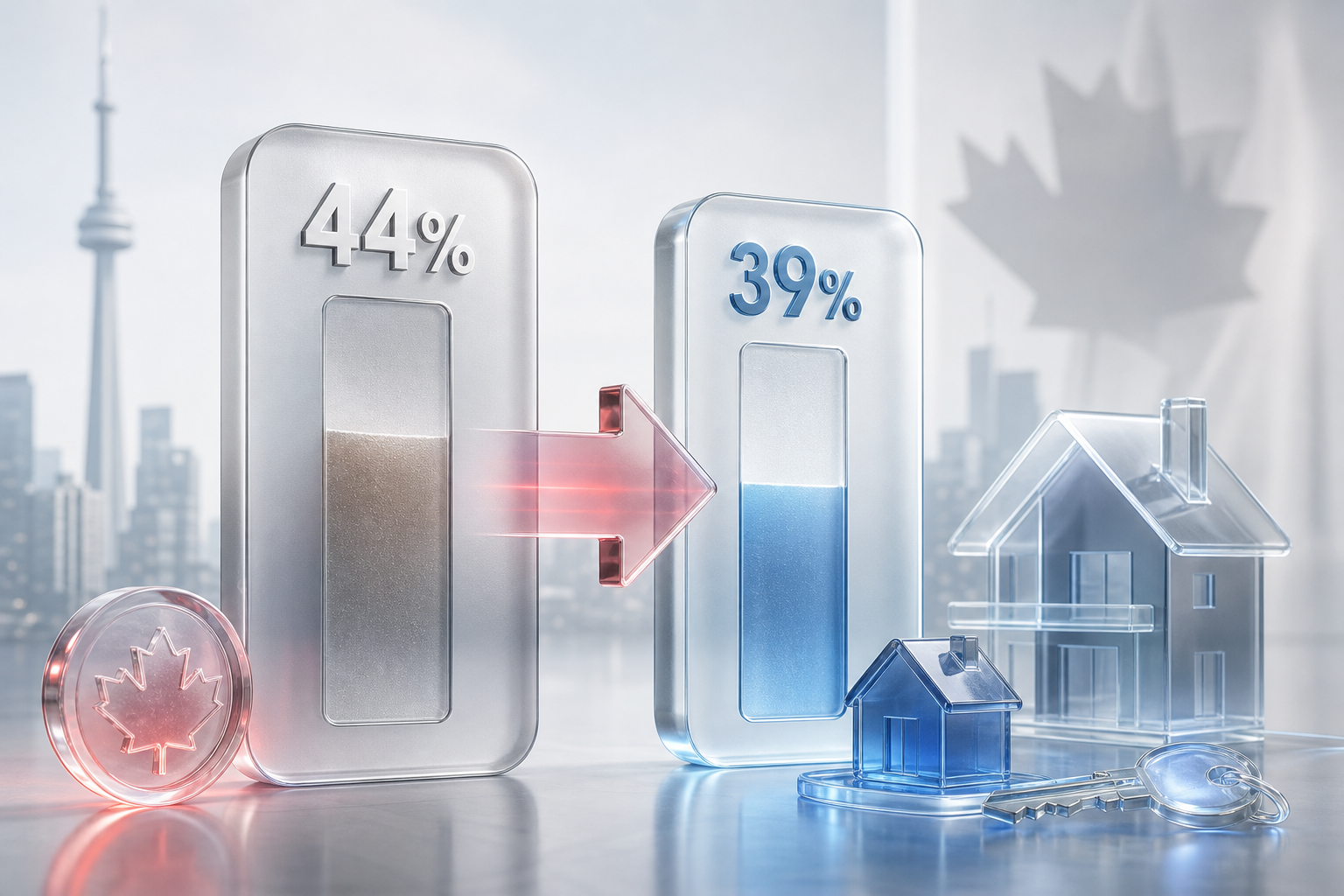
In 2024, CMHC tightened the GDS limit from 44% to 39% of gross household income. That five-point drop doesn't sound like much. But on a household pulling in $11,600 a month, it means $580 less per month can go toward housing costs before a lender closes the door. At current rates, $580 monthly translates to roughly $95,000 in lost borrowing capacity. The buyer's financials didn't worsen. The goal posts moved.
And most people find out only after they've made an offer.
What the
You clear the credit check, you have the down payment, and your income looks strong on paper. The lender still tells you that you qualify for $87,000 less than you expected. Nobody explains why.
The constraint that just failed you wasn't income. It was the Gross Debt Service ratio, a ceiling that governs how much of your gross monthly pay can go toward housing costs before the system closes the door. CMHC maintains a maximum GDS ratio of 39% (as of April 15, 2026), and that figure acts as a hard mathematical limit regardless of how high your credit score climbs or how stable your job appears.
The ratio works like this. Take your gross monthly income, the number before taxes, and multiply by 0.39. That amount is the absolute maximum you can spend each month on mortgage principal, interest, property taxes, heating, and half of condo fees. A household earning $11,600 gross hits the ceiling at $4,524. If property taxes run $400, heat costs $150, and condo fees add $300 (half counted), you have $3,674 left for the mortgage payment. At a 5.5% stress test rate on a 25-year amortization, that supports a mortgage of roughly $580,000. Not $675,000. The GDS ratio decided.
Where the Math Becomes Invisible
Most buyers focus on two numbers: credit score and down payment percentage. Both matter. Neither is the binding constraint for middle-income households in urban Canada. The GDS ratio often binds first, and it binds silently.
Consider a software developer in Mississauga earning $140,000. She saves 20% down over six years, which puts her in the uninsured mortgage category and avoids CMHC insurance premiums. Her credit score sits at 780. She uses an online calculator, inputs her income and down payment, and sees a maximum purchase price near $850,000. She makes an offer at $825,000.
Then the lender runs the actual calculation. Property taxes on an $825,000 home in Mississauga run roughly $7,200 annually, or $600 monthly. Heat for a 1,400-square-foot detached house averages $180 in current utility pricing. Her gross monthly income is $11,667. At 39%, the GDS ceiling is $4,550. Subtract $600 for taxes and $180 for heat, leaving $3,770 for the mortgage payment. At the stress test rate, that supports a mortgage of $595,000. With her $165,000 down payment, she qualifies for a purchase price near $760,000. The difference is $65,000 from what she expected, because the lender cannot allocate as much of her income to housing as the online calculator assumed.
The 39% cap is set by regulation. The lender has no authority to move it.
The Components That Squeeze
The GDS formula counts four things: mortgage payment, property taxes, heating, and 50% of condo fees. Three of those have risen faster than incomes in the last five years.
Property tax rates in the Greater Toronto Area increased between 2.1% and 3.8% annually from 2021 through 2026, compounding on assessed values that also climbed. A home assessed at $750,000 in 2021 now carries taxes roughly 18% higher even if the rate held flat, because the assessment rose.
Heating costs spiked. Natural gas prices in Ontario increased 34% between 2021 and 2024, and carbon pricing added another layer. A home that cost $110 monthly to heat in 2021 now runs $165 for the same square footage. Lenders often use standardized heating estimates rather than actual bills, and those estimates have risen to reflect current energy costs. For a 1,600-square-foot home, many lenders now input $200 monthly for heat, regardless of what the seller's utility bills show.
Condo fees have not been static either. Buildings that deferred maintenance during the pandemic are catching up with special assessments and fee hikes. A building charging $450 monthly in fees in 2023 might charge $550 in 2026. Because lenders count half the fee in the GDS calculation, that $100 increase costs the buyer $50 of monthly capacity, which translates to roughly $8,200 in lost mortgage room at a 5.5% stress test rate.
These shifts eat the 39% bucket from the bottom, leaving less room for the mortgage itself. The buyer's income may have grown 3% annually over the same period. The components of the GDS grew faster.
The Uninsured Exception
Borrowers with at least 20% down payment bypass CMHC mortgage insurance, which also means they bypass CMHC's ratio limits, in theory. In practice, federally regulated lenders apply the same 39% GDS standard to uninsured mortgages under OSFI's B-20 guideline because the stress test rules are written into banking law and applied across all lending, not just insured mortgages. A few credit unions and private lenders stretch to 42% or 44%, but they charge 60 to 90 basis points more in rate. The buyer trades ratio flexibility for higher interest cost, which reduces affordability by a different route.
The 39% cap is structural. It does not care that you have been in the same job for nine years or that your income is trending up. It measures one thing: the percentage of gross income allocated to shelter in the month the mortgage funds. If that percentage exceeds 39%, the file does not move forward.
Most buyers discover this in the final week before a financing condition expires. The limit was always there, but most brokers and real estate agents do not mention it before a buyer makes an offer. That silence is the problem, and it is not getting smaller.




You earn $140,000. Your credit score sits at 780. You saved a 20% down payment over six years. Then a lender tells you the maximum mortgage is $87,000 lower than you calculated online, and nobody can explain why in plain language.
The constraint isn't your credit. It's a number most buyers have never heard of: the Gross Debt Service ratio, and it just changed.
In 2024, CMHC tightened the GDS limit from 44% to 39% of gross household income. That five-point drop doesn't sound like much. But on a household pulling in $11,600 a month, it means $580 less per month can go toward housing costs before a lender closes the door. At current rates, $580 monthly translates to roughly $95,000 in lost borrowing capacity. The buyer's financials didn't worsen. The goal posts moved.
And most people find out only after they've made an offer.
What the
You clear the credit check, you have the down payment, and your income looks strong on paper. The lender still tells you that you qualify for $87,000 less than you expected. Nobody explains why.
The constraint that just failed you wasn't income. It was the Gross Debt Service ratio, a ceiling that governs how much of your gross monthly pay can go toward housing costs before the system closes the door. CMHC maintains a maximum GDS ratio of 39% (as of April 15, 2026), and that figure acts as a hard mathematical limit regardless of how high your credit score climbs or how stable your job appears.
The ratio works like this. Take your gross monthly income, the number before taxes, and multiply by 0.39. That amount is the absolute maximum you can spend each month on mortgage principal, interest, property taxes, heating, and half of condo fees. A household earning $11,600 gross hits the ceiling at $4,524. If property taxes run $400, heat costs $150, and condo fees add $300 (half counted), you have $3,674 left for the mortgage payment. At a 5.5% stress test rate on a 25-year amortization, that supports a mortgage of roughly $580,000. Not $675,000. The GDS ratio decided.
Where the Math Becomes Invisible
Most buyers focus on two numbers: credit score and down payment percentage. Both matter. Neither is the binding constraint for middle-income households in urban Canada. The GDS ratio often binds first, and it binds silently.
Consider a software developer in Mississauga earning $140,000. She saves 20% down over six years, which puts her in the uninsured mortgage category and avoids CMHC insurance premiums. Her credit score sits at 780. She uses an online calculator, inputs her income and down payment, and sees a maximum purchase price near $850,000. She makes an offer at $825,000.
Then the lender runs the actual calculation. Property taxes on an $825,000 home in Mississauga run roughly $7,200 annually, or $600 monthly. Heat for a 1,400-square-foot detached house averages $180 in current utility pricing. Her gross monthly income is $11,667. At 39%, the GDS ceiling is $4,550. Subtract $600 for taxes and $180 for heat, leaving $3,770 for the mortgage payment. At the stress test rate, that supports a mortgage of $595,000. With her $165,000 down payment, she qualifies for a purchase price near $760,000. The difference is $65,000 from what she expected, because the lender cannot allocate as much of her income to housing as the online calculator assumed.
The 39% cap is set by regulation. The lender has no authority to move it.
The Components That Squeeze
The GDS formula counts four things: mortgage payment, property taxes, heating, and 50% of condo fees. Three of those have risen faster than incomes in the last five years.
Property tax rates in the Greater Toronto Area increased between 2.1% and 3.8% annually from 2021 through 2026, compounding on assessed values that also climbed. A home assessed at $750,000 in 2021 now carries taxes roughly 18% higher even if the rate held flat, because the assessment rose.
Heating costs spiked. Natural gas prices in Ontario increased 34% between 2021 and 2024, and carbon pricing added another layer. A home that cost $110 monthly to heat in 2021 now runs $165 for the same square footage. Lenders often use standardized heating estimates rather than actual bills, and those estimates have risen to reflect current energy costs. For a 1,600-square-foot home, many lenders now input $200 monthly for heat, regardless of what the seller's utility bills show.
Condo fees have not been static either. Buildings that deferred maintenance during the pandemic are catching up with special assessments and fee hikes. A building charging $450 monthly in fees in 2023 might charge $550 in 2026. Because lenders count half the fee in the GDS calculation, that $100 increase costs the buyer $50 of monthly capacity, which translates to roughly $8,200 in lost mortgage room at a 5.5% stress test rate.
These shifts eat the 39% bucket from the bottom, leaving less room for the mortgage itself. The buyer's income may have grown 3% annually over the same period. The components of the GDS grew faster.
The Uninsured Exception
Borrowers with at least 20% down payment bypass CMHC mortgage insurance, which also means they bypass CMHC's ratio limits, in theory. In practice, federally regulated lenders apply the same 39% GDS standard to uninsured mortgages under OSFI's B-20 guideline because the stress test rules are written into banking law and applied across all lending, not just insured mortgages. A few credit unions and private lenders stretch to 42% or 44%, but they charge 60 to 90 basis points more in rate. The buyer trades ratio flexibility for higher interest cost, which reduces affordability by a different route.
The 39% cap is structural. It does not care that you have been in the same job for nine years or that your income is trending up. It measures one thing: the percentage of gross income allocated to shelter in the month the mortgage funds. If that percentage exceeds 39%, the file does not move forward.
Most buyers discover this in the final week before a financing condition expires. The limit was always there, but most brokers and real estate agents do not mention it before a buyer makes an offer. That silence is the problem, and it is not getting smaller.
Read Next
What 27 Rising Stars Under 40 Reveal About Canada's Next Wealth Model
The Deficit Fell $11.6 Billion. Your Mortgage Rate Didn't Get the Memo.
Banks Call It a Transfer Fee, but It Works Like an Exit Penalty
Leveraged Insurance Ends When Regulators See the Downside, Whatever the Math Says